TrafficSim
See what changes across the road network. TrafficSim combines map-based study setup, explicit demand assumptions, bounded option comparisons and transparent evidence in one exploratory workspace.
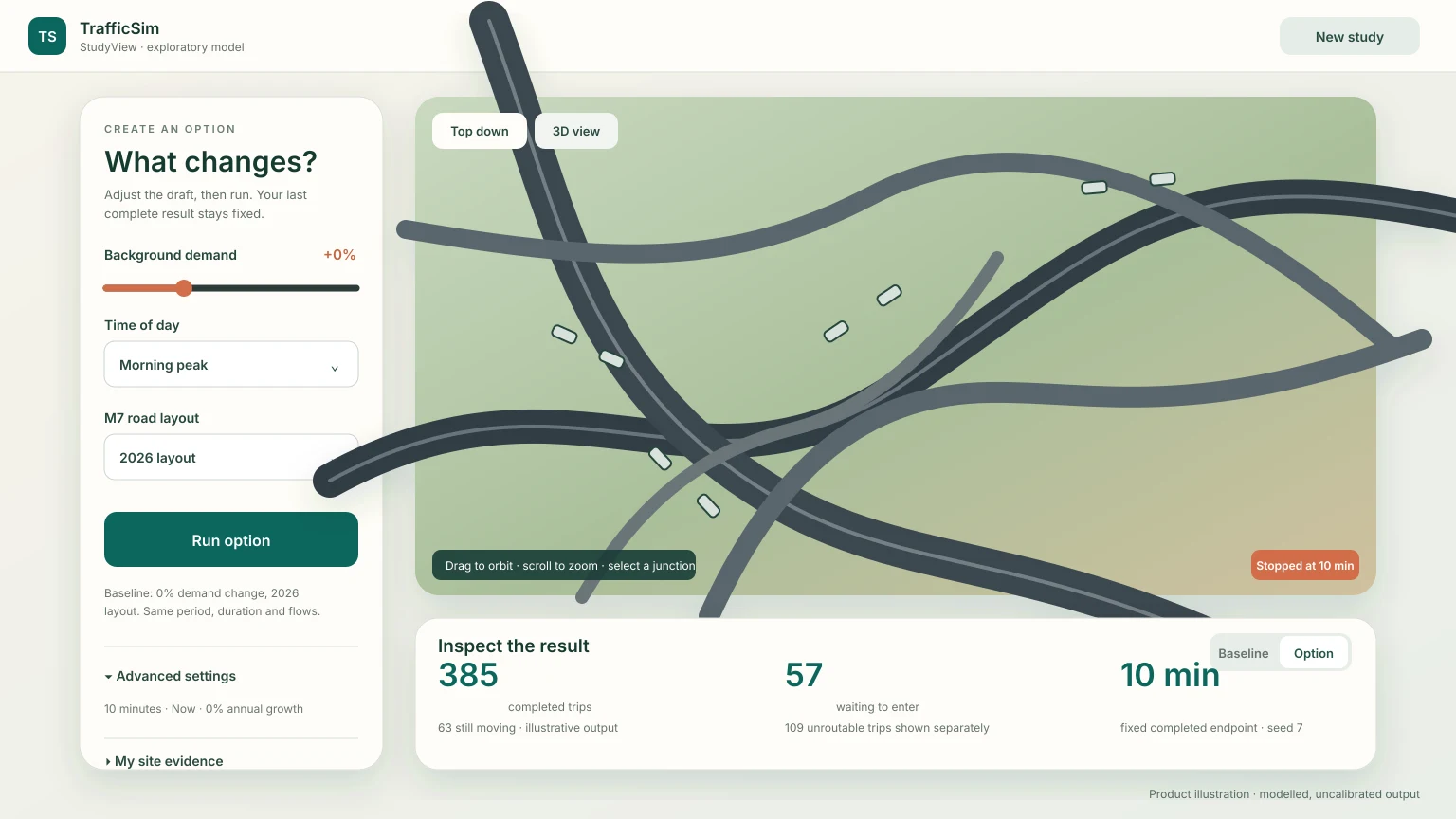
Product illustration · modelled, uncalibrated output
A bounded study workflow
Choose the area. State the change. Inspect the result.
TrafficSim keeps the study area, evidence, demand and option definition visible. The public simulator demonstrates the current engine; the StudyView release candidate adds a guided map-first workflow around ready samples while fresh-area processing remains local-only.
Open TrafficSim- 01
Choose a ready study area and record any local reference evidence.
- 02
Define a bounded option without silently changing the matched baseline.
- 03
Run, inspect and export the completed study with its limitations attached.
Evidence before confidence
A traffic result should show how it was produced.
TrafficSim is designed to keep inputs, source status, run identity and modelling limits close to the visual result—so an exploratory model is not mistaken for measured road performance.
Transparent setup
Select a known area, period and duration; keep optional roadside counts and site-photo metadata clearly separate from generated demand.
Matched comparison
Baseline and option share the same period, duration, seed and explicit added flows, making the intended change easier to explain.
Results that stay fixed
Editing a draft does not relabel the last completed run. Export uses the captured settings and model identity behind that result.
StudyView workflow
From map selection to an inspectable option study.
These illustrations summarise the current StudyView release candidate: guided setup, a bounded simulation workspace, and results with evidence and model limits nearby.
Product illustrations based on the current local beta. Values are illustrative model output, not measured traffic or a certified forecast.
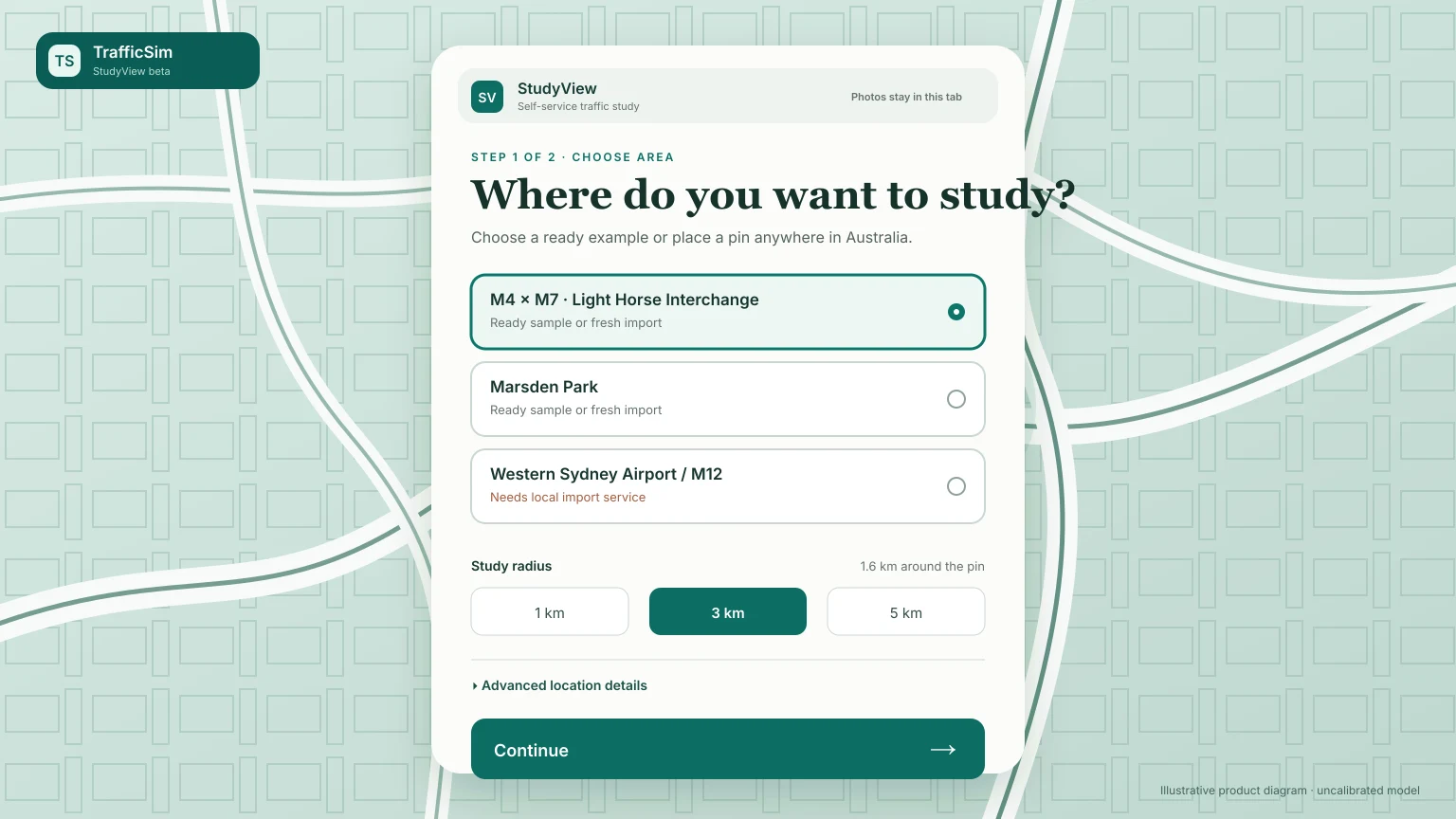
Choose the study area
Start from a ready M4/M7 or Marsden Park sample, or define a local area for fresh import when the processing service is available.
Run a bounded option
Adjust supported controls, preserve the matched baseline and keep the most recent completed result fixed until another run succeeds.
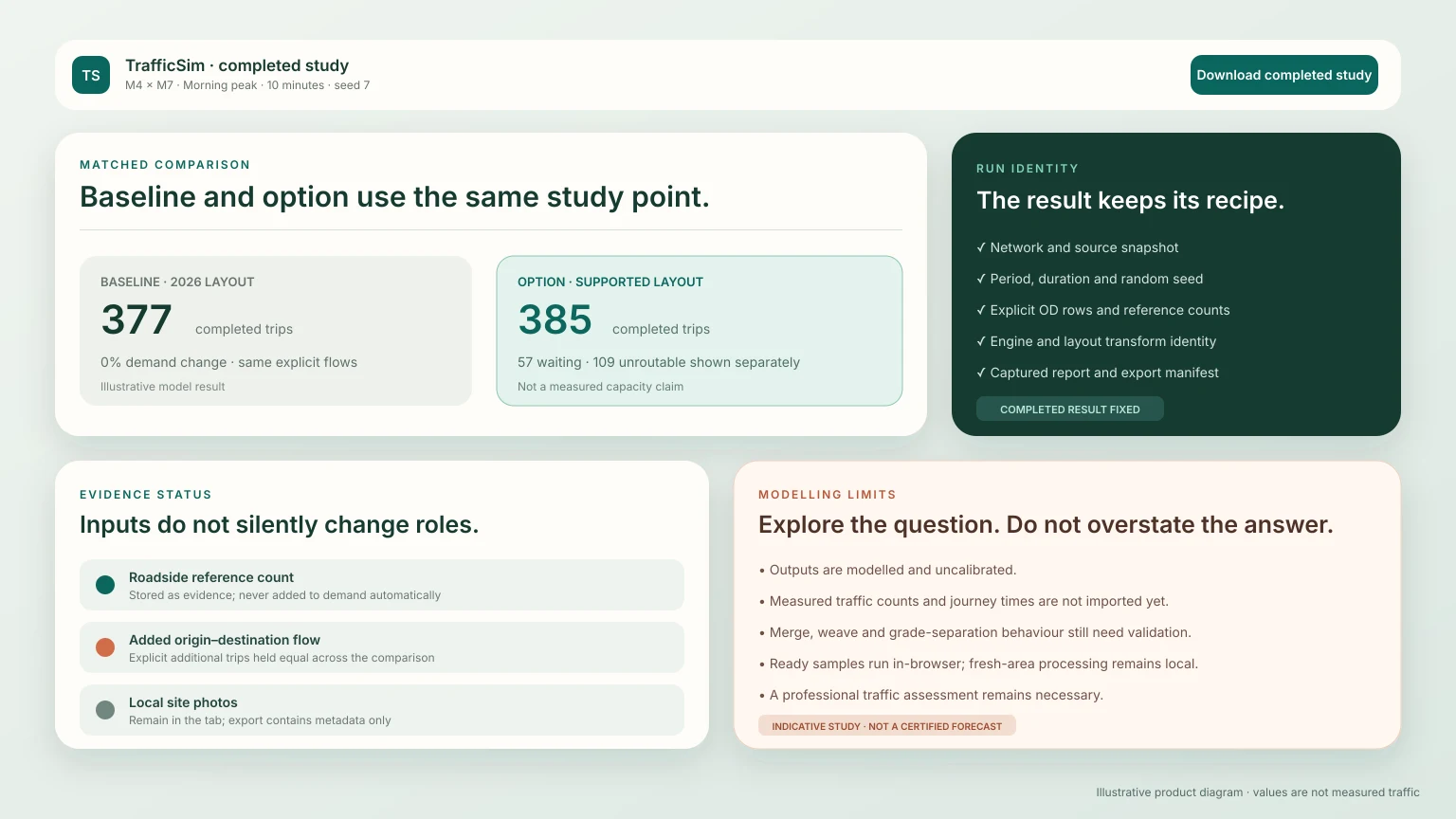
Inspect evidence and limits
Review modelled flow, incomplete trips, junction detail, source status and the exact run identity before exporting the study.
Ideal for
- Transport and infrastructure teams exploring an option before formal assessment
- Councils, developers and communities discussing where modelled traffic may move
- Practitioners who want assumptions, source notes and limitations beside the result
- Product teams testing evidence-led transport workflows and scenario interfaces
Key outcomes
- Start from a ready road-network sample and understand exactly what it contains
- Compare one option with a matched baseline using the same period, duration and seed
- Inspect modelled movement, road flows, junction detail and incomplete demand together
- Export a completed study with its captured settings, evidence metadata and model identity
Current product foundations
- Public Marsden Park 3D simulator with corridor, day-cycle and demand experiments
- Map-first StudyView release candidate with ready M4/M7 and Marsden Park networks
- Explicit demand, time-of-day, duration, growth and supported layout controls
- Roadside reference counts kept separate from additional origin-destination demand
- Deterministic browser simulation with fixed completed results and expandable evidence
- Downloadable JSON study bundles preserving settings, reports and provenance
Proposed interface direction
- Public `/study/` release with ready samples and saved-file imports
- Hosted fresh-area processing beyond the current local-only import service
- Background-worker execution for cancellable baseline and option runs
- Recorded replay with fixed-location flow and queue comparisons
- Better grade separation plus independently validated merge and weave behaviour
Security & governance
- TrafficSim clearly labels modelled output as exploratory and uncalibrated
- Local site photos remain in the browser tab; exports contain metadata rather than images
- Ready samples retain their source and model identity instead of silently adopting new claims
- Fresh-area imports depend on public map services and the local processing service today
- The product does not replace measured surveys, engineering review or a certified traffic study
Start with the road network, not a promise
TrafficSim is NeoSpark Solutions’ exploratory transport-modelling product. Its public Marsden Park experience lets people investigate corridor, demand and day-cycle scenarios on a recognisable 3D road network. The newer StudyView beta adds a map-first setup path, ready M4/M7 and Marsden Park samples, optional local evidence and a clearer baseline-versus-option workflow.
It is deliberately not presented as a certified traffic study. The model can help a team frame a question, inspect how assumptions behave and identify where measured evidence is still needed. It cannot establish real traffic volumes, investment benefits or road safety outcomes without calibration and professional review.
One option, with the comparison held steady
StudyView captures the period, duration, seed, network and explicitly added origin-destination flows used by a run. The baseline and option use the same comparison settings. Changing a draft after completion leaves the prior figures intact, so a new control value cannot quietly relabel an old result.
Today’s movement foundation also removes artificial braking between compatible road segments, checks available lane space before a vehicle enters, and processes transfers deterministically when equivalent road data arrives in a different order. These are software invariants, not proof of real-world calibration.
Evidence remains evidence
A roadside count is stored as a dated reference rather than silently becoming extra demand. Site photos stay in the local browser tab and exports retain only their metadata. Completed JSON bundles preserve the effective settings, reports and model identity needed to reproduce or challenge the result.
Honest limits and the next gate
The public Marsden simulator is live. StudyView is being prepared for the public /study/ route, where ready samples and saved JSON files can run in the browser. Fresh-area processing still needs its local Node service and public OpenStreetMap services. Background-worker execution, recorded replay, visual queue comparisons, better grade separation and realistic merge behaviour remain the next engineering gates.
TrafficSim output is indicative and uncalibrated. Measured counts, journey times, signal plans and transport-engineering validation remain necessary before using a result for investment, planning approval or operational decisions.
Why teams choose TrafficSim
We combine architecture-led thinking with AI acceleration to deliver products that feel premium, governed, and production-ready.
Want to discuss the product?
Connect with NeoSpark Solutions to explore a product partnership, destination experience, or a related idea.
Get In Touch