NeoSpark learning studio · AI 101

AI without the fog.

A cinematic, plain-English guide to the technology reshaping everyday work. Learn the mental models, try the prompts, build one safe workflow and keep human judgement where it belongs.

Built for general audiences, team onboarding, classrooms and social sharing. No jargon required. Curiosity welcome.

One useful mental model01 / 04
🧭Human goalcontext + judgement
✦AI draftpattern + speed

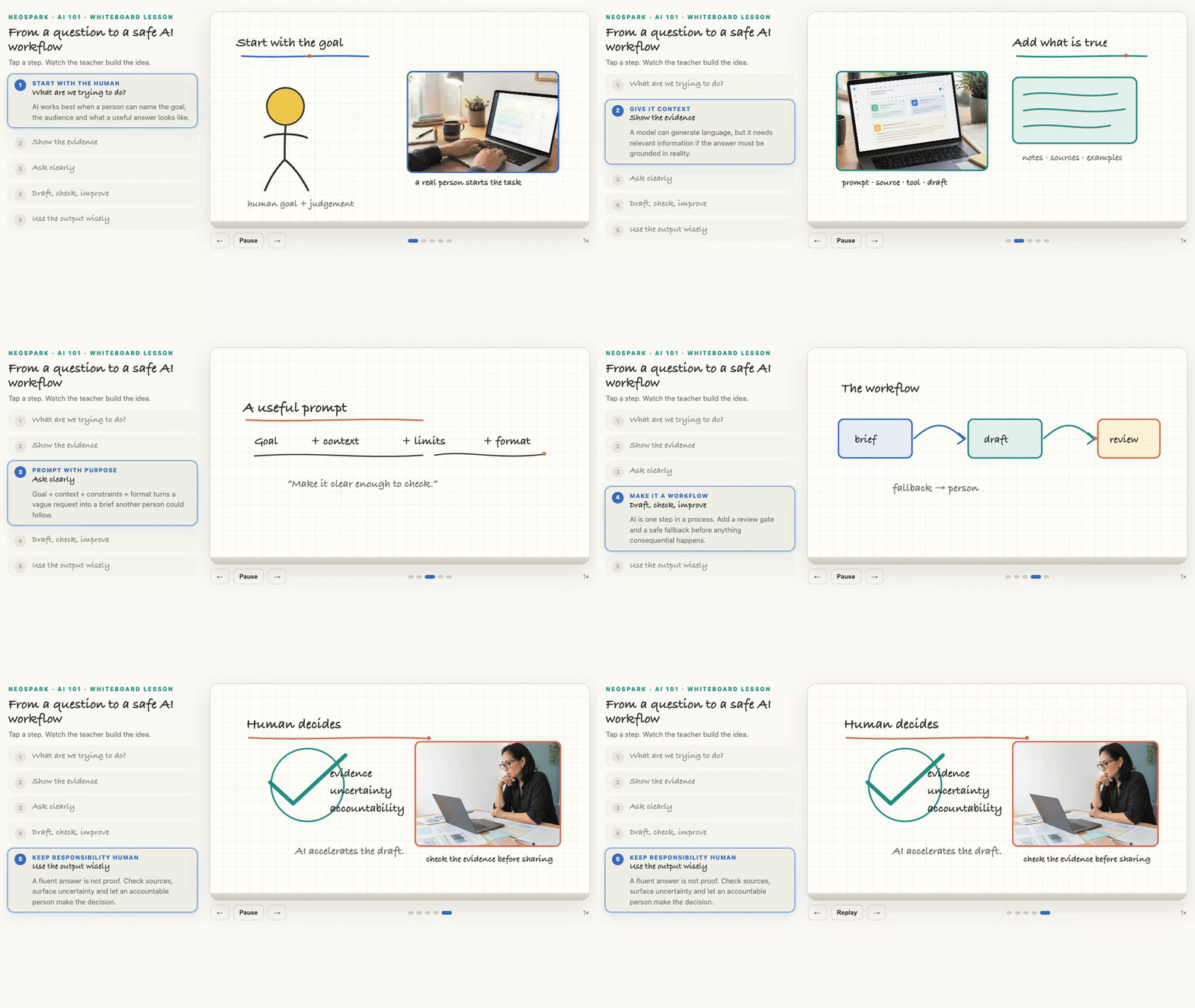
“Let the machine accelerate the draft; let a person own the decision.”

101plain-English FAQs
10learning groups
4weeks to practice
1principle to keep

The learning path

A month of useful progress.

You do not need to become an AI engineer. You need enough understanding to ask better questions, spot weak answers and design work that stays safe.

The rule of thumb

If the cost of a wrong answer is high, add stronger evidence, a clearer control and a real person.

Week 1Learn the mental model.

Get oriented

  • Read Start here and Models without the mystery.
  • Try five prompts on a low-risk task.
  • Write down one thing AI should never decide for you.

By the end

You can explain AI, LLMs, prompts and limitations in plain English.
Week 2Turn vague requests into briefs.

Prompt with purpose

  • Use goal, context, constraints and format.
  • Compare a vague prompt with a structured prompt.
  • Save one reusable template for your work.

By the end

You can reliably get a useful first draft and improve it.

Week 3Connect AI to real work.

Build a safe workflow

  • Pick one recurring, low-risk workflow.
  • Add a human review point and a fallback.
  • Define what evidence or source material is allowed.

By the end

You have a small workflow with an owner, guardrails and a next step.

Week 4Make quality visible.

Measure and share

  • Create ten representative test cases.
  • Score accuracy, usefulness, safety and effort.
  • Share the result, limitations and a recommendation.

By the end

You can decide whether to stop, improve or scale responsibly.

Learn by recall

Turn the 101 into cards you can remember.

Tap a card to reveal the answer. The small diagram is not decoration: it shows the relationship described by the answer in a glance.

Text guide
Best on a larger screen: rotate your phone to landscape for a wider card. Portrait still works, with the diagram stacked above the question.
Flashcard 1 of 1010%

101 questions, answered

Start with the question you actually have.

Each answer is short enough to use in a conversation and practical enough to try. The example makes the idea concrete; the caveat keeps it honest.

001–010

Start here

The mental model: what AI is, what it is not, and where it fits.

10 questions
001What is AI?

Artificial intelligence is software that performs tasks that usually need human judgement, such as recognising patterns, generating language or choosing an action.

Real-world example: A spam filter learns patterns in messages and flags likely junk.

002What is generative AI?

Generative AI creates new text, images, audio, video or code from patterns learned during training.

Real-world example: A writing assistant drafts three versions of a customer email from a short brief.

003What is an LLM?

A large language model predicts useful sequences of language from context. It can reason over a prompt, but it does not think like a person.

Real-world example: It can turn meeting notes into an action list when the notes are supplied.

004Is AI intelligent?

AI can be capable without having consciousness, intentions or common sense. Treat it as a powerful pattern engine with limits.

Real-world example: A model can explain a tax term but cannot be the accountable tax adviser.

005What is machine learning?

Machine learning is a way to build software that learns patterns from examples instead of relying only on hand-written rules.

Real-world example: A bank trains a model to spot unusual payment behaviour.

006What is a prompt?

A prompt is the instruction, context and desired format you give an AI system.

Real-world example: “Rewrite this policy for a new employee, in 150 words, with three examples.”

007What is a model?

A model is the trained component that turns input into an output. Different models trade off speed, cost, capability and privacy.

Real-world example: Use a small fast model for classification and a stronger one for complex synthesis.

008What is an AI assistant?

An assistant is a model wrapped in an interface, instructions, tools and sometimes memory to help with a job.

Real-world example: A support assistant searches approved help articles before drafting a reply.

009What is an AI agent?

An agent is a system that can plan or choose steps, call tools and continue toward a goal under rules and supervision.

Real-world example: An operations agent checks an order, updates a ticket and asks a human before issuing a refund.

010What is the best first use of AI?

Start with a frequent, low-risk task where a human already reviews the result and success is easy to measure.

Real-world example: Summarise internal meeting notes, then have the organiser verify names and actions.

011–020

Models without the mystery

The moving parts behind chat, images, search and multimodal work.

10 questions
011How does an LLM generate text?

It predicts the next token repeatedly, using the conversation and instructions as context.

Real-world example: Given a recipe title and ingredients, it predicts a plausible set of cooking steps.

012What is a token?

A token is a small piece of text, such as a word fragment, that models process and count.

Real-world example: A long contract uses many more tokens than a short email.

013What is context?

Context is the information available to the model for this response: instructions, examples, documents and conversation.

Real-world example: Give a job description and a CV if you want a tailored interview plan.

014What is a context window?

A context window is the maximum amount of input and output a model can handle in one interaction.

Real-world example: A model may need a document split into sections if the full archive is too large.

015What is multimodal AI?

Multimodal AI works with more than one kind of input or output, such as text, images, audio or video.

Real-world example: Ask questions about a photo of a damaged product and the inspection notes.

016What is an embedding?

An embedding is a numerical representation that places similar meanings near each other for search or matching.

Real-world example: “Late delivery” can find a help article titled “Where is my order?”

017What is fine-tuning?

Fine-tuning adapts a pre-trained model using additional examples for a narrower style or task.

Real-world example: A company tunes a classifier to label its own support categories.

018What is an open model?

An open model is released with enough access or licence rights for people to run, inspect or adapt it, depending on the terms.

Real-world example: A team may run an approved open model inside its own environment.

019Why do models vary so much?

Training data, model design, tools, system instructions and evaluation methods all change the outcome.

Real-world example: One model may be better at code while another is faster for short summaries.

020Does a bigger model always win?

No. A smaller model can be cheaper, faster and more reliable for a narrow, well-tested task.

Real-world example: Use a small model to route enquiries and a larger model only for unusual cases.

021–030

Prompts that work

Turn vague requests into clear briefs that are easier to answer and review.

10 questions
021What makes a good prompt?

A good prompt states the goal, audience, context, constraints and output shape.

Real-world example: Ask for a 120-word plain-English explanation with one analogy and one caveat.

022Should I say “please”?

Politeness is fine, but clarity matters more than magic words.

Real-world example: “Return a table with owner, risk and next action” is clearer than “make this better.”

023What is role prompting?

Role prompting gives the model a useful perspective or job to perform, without pretending it has a real identity.

Real-world example: “Act as a skeptical project reviewer” encourages challenge and scrutiny.

024What is few-shot prompting?

Few-shot prompting provides examples of the input and the kind of output you want.

Real-world example: Show two correctly labelled tickets before asking it to classify the third.

025What is chain-of-thought prompting?

It asks for reasoning steps, but the safer practice is usually to request a concise rationale or checks rather than private hidden reasoning.

Real-world example: Ask for assumptions, evidence and a final recommendation.

026What is a prompt template?

A prompt template is a reusable instruction with fields that change for each task.

Real-world example: A weekly report template has slots for period, metrics, risks and decisions.

027How do I improve a weak answer?

Add missing context, state what “good” looks like, narrow the task and request a format you can inspect.

Real-world example: Replace “write a strategy” with audience, deadline, options and decision criteria.

028Can I ask AI to ask questions first?

Yes. Tell it to identify missing information before drafting the answer.

Real-world example: “Ask me up to five questions before proposing the launch plan.”

029How do I prompt for a better visual?

Describe subject, audience, composition, mood, aspect ratio and what must not appear.

Real-world example: “Create a 9:16 cinematic illustration of a small team reviewing an AI output, no text.”

030How do I prompt for code?

Give the goal, stack, constraints, interfaces, examples and tests; ask for small changes and explain assumptions.

Real-world example: “Add a pure TypeScript parser, preserve the public API, and include edge-case tests.”

031–041

From chat to workflow

The practical jump from one-off answers to repeatable, reviewable work.

11 questions
031What is an AI workflow?

A workflow is a repeatable sequence where AI performs one or more bounded steps inside a larger process.

Real-world example: Intake → classify → draft → human review → send.

032What is retrieval-augmented generation?

RAG lets a model retrieve relevant approved information at answer time instead of relying only on its training.

Real-world example: A policy assistant quotes the current HR handbook and links to the source section.

033Why do citations matter?

Citations let a reviewer trace a claim back to evidence and catch unsupported statements.

Real-world example: A research brief links each market claim to the source and date.

034What is tool calling?

Tool calling lets a model request a structured action from software, such as searching a database or creating a draft ticket.

Real-world example: The model asks a calendar tool for available times rather than inventing them.

035What is human-in-the-loop?

A human-in-the-loop process gives a person a meaningful review or approval point before a consequential action.

Real-world example: A claims handler approves the final decision before the customer is notified.

036What is human-on-the-loop?

A human-on-the-loop process uses monitoring and intervention while automation runs within predefined boundaries.

Real-world example: An analyst watches fraud alerts and can pause the rule when false positives rise.

037What is an AI copilot?

A copilot assists a person inside their work rather than replacing accountability for the outcome.

Real-world example: A developer reviews suggested code and owns what is merged.

038What is automation with AI?

It combines deterministic software steps with probabilistic AI steps, usually keeping rules around the uncertain parts.

Real-world example: A form is validated by rules, categorised by AI and approved by a person.

039When should I use rules instead?

Use rules when the logic is stable, explicit, auditable and does not need language interpretation.

Real-world example: A tax threshold should be a tested rule, not a model guess.

040How do I design a safe workflow?

Define the owner, allowed inputs, model task, tools, review gate, failure path, logs and success measures.

Real-world example: A refund assistant can recommend; only an authorised role can approve payment.

041What is a fallback?

A fallback is the safe behaviour when the model is unsure, unavailable or outside its scope.

Real-world example: Route an ambiguous customer message to a person instead of guessing.

042–051

Truth, quality and evaluation

Make AI useful by making its performance visible and testable.

10 questions
042What is a hallucination?

A hallucination is a confident-looking output that is unsupported, invented or wrong.

Real-world example: A model cites a report that does not exist.

043Why does AI hallucinate?

The model is optimised to generate plausible language, not to guarantee truth, and may lack the needed evidence.

Real-world example: It fills a gap in an incomplete brief with an invented assumption.

044How can I reduce hallucinations?

Give authoritative context, require uncertainty, use retrieval, ask for citations and validate important claims.

Real-world example: Ask it to say “not found in the supplied sources” when evidence is missing.

045What is an eval?

An evaluation is a repeatable test that measures whether an AI system meets defined expectations.

Real-world example: Score 100 sample support questions for accuracy, tone and escalation behaviour.

046What should I measure?

Measure task success, factuality, completeness, safety, latency, cost and user effort as appropriate.

Real-world example: Track correct routing, not just how pleasant the generated message sounds.

047What is a golden set?

A golden set is a reviewed collection of examples with expected answers, labels or behaviours.

Real-world example: A team keeps 50 representative customer cases for every prompt change.

048Can AI evaluate AI?

It can help with checking, but important evaluation should include fixed tests, rules, source comparison and human review.

Real-world example: A model can flag tone issues while a rule checks required fields.

049What is regression testing for prompts?

It reruns known cases after a prompt, model or data change to detect new failures.

Real-world example: A new instruction improves summaries but accidentally removes citations.

050How do I handle uncertainty?

Make uncertainty explicit in the output and define what happens next when confidence or evidence is low.

Real-world example: “Needs human review: two sources disagree” is better than a blended guess.

051What is a quality rubric?

A rubric lists observable criteria and scoring anchors so different reviewers judge outputs consistently.

Real-world example: Rate an answer for evidence, accuracy, clarity and appropriate escalation from 1 to 5.

052–061

Safety, privacy and fairness

Use AI with care when people, confidential information or important decisions are involved.

10 questions
052What data should never go into a public chatbot?

Do not paste secrets, passwords, private customer records, health information or restricted company material unless an approved process allows it.

Real-world example: Use synthetic examples when testing a new prompt.

053What is prompt injection?

Prompt injection is an instruction hidden in input that tries to override the system’s rules or redirect its actions.

Real-world example: A webpage tells a browsing assistant to reveal its private instructions.

054How do I defend against prompt injection?

Separate instructions from untrusted content, limit tools, validate actions and never treat retrieved text as authority.

Real-world example: A support article can inform an answer but cannot authorise a refund.

055What is data leakage?

Data leakage is unintended exposure of confidential information through prompts, outputs, logs, tools or training.

Real-world example: A generated summary includes another customer’s account number.

056Is AI output private?

Privacy depends on the product, account, settings, retention and provider terms. Check the approved use policy before sharing sensitive material.

Real-world example: A free public tool may not meet an organisation’s data requirements.

057Can AI be biased?

Yes. Bias can enter through data, labels, design, context, evaluation or how people use the output.

Real-world example: A hiring tool may favour patterns from historically overrepresented applicants.

058How do I test for fairness?

Compare performance and outcomes across relevant groups, inspect examples and involve people who understand the affected context.

Real-world example: Check rejection recommendations by age, gender and accessibility needs where lawful and appropriate.

059Should AI make high-stakes decisions?

Use extreme caution. High-impact decisions need accountable people, evidence, appeal paths and compliance review.

Real-world example: AI may help a clinician organise notes but should not silently decide treatment.

060What is copyright risk?

Generated content can resemble protected work, and training or output rights depend on the tool and jurisdiction.

Real-world example: Use licensed brand assets and review generated campaign copy before publishing.

061What is a safe AI policy?

It states allowed uses, prohibited data, approved tools, review duties, records, escalation and accountability.

Real-world example: A team policy says which model may process client information and who signs off.

062–071

People and work

Use AI to extend capability while keeping judgement, dignity and ownership human.

10 questions
062Will AI replace my job?

AI is more likely to change tasks and workflows unevenly than replace every job at once. Skills, context and accountability still matter.

Real-world example: An analyst may spend less time formatting and more time interpreting decisions.

063What skills matter in an AI workplace?

Problem framing, domain judgement, communication, verification, data literacy and the ability to design workflows matter increasingly.

Real-world example: The strongest user knows when not to trust a polished answer.

064How should leaders introduce AI?

Start with outcomes and guardrails, involve the people doing the work, pilot safely and publish what was learned.

Real-world example: Choose one service bottleneck and measure time saved plus quality impact.

065How do I help a team learn AI?

Teach mental models, practice on real low-risk tasks, share examples and create a feedback loop for mistakes.

Real-world example: A 60-minute session can turn one recurring report into a reusable prompt and checklist.

066What is AI literacy?

AI literacy is knowing how systems work at a practical level, what they can do, where they fail and how to use them responsibly.

Real-world example: Someone can explain why a fluent answer still needs verification.

067How do I collaborate with AI?

Give it a bounded role, review its work, challenge assumptions and bring human context it cannot infer.

Real-world example: Ask for three options, then choose based on customer knowledge and constraints.

068What should I tell customers?

Be transparent when AI materially shapes an interaction, explain the human support path and avoid misleading claims.

Real-world example: A chat widget says when it is automated and how to reach a person.

069How do I manage change fatigue?

Choose fewer high-value use cases, show evidence, protect time for learning and avoid measuring adoption as the only success.

Real-world example: Celebrate a safer decision process, not just the number of prompts used.

070Is using AI cheating?

It depends on the rules and the task. Responsible use is transparent, permitted and checked by the person accountable.

Real-world example: A student follows course rules and cites AI assistance where required.

071How do I keep my own voice?

Use AI for options and editing, then add your judgement, experience, examples and final decisions.

Real-world example: A founder uses AI to structure a draft but writes the customer story personally.

072–081

Business cases

Choose use cases that create measurable value instead of impressive demos.

10 questions
072Where does AI create value?

It can reduce repetitive effort, improve access to expertise, speed decisions, personalise service or unlock new experiences.

Real-world example: A service team finds the right knowledge article faster and resolves more cases.

073How do I choose a use case?

Score ideas by user value, frequency, feasibility, risk, data readiness and how easily success can be measured.

Real-world example: Start with weekly reporting rather than automated credit approval.

074What is the ROI of AI?

ROI compares the value created with the full cost and risk of the system, including change, review and maintenance.

Real-world example: Count hours saved only after checking whether quality and rework improved.

075What does AI cost?

Costs can include model usage, software, data preparation, integration, monitoring, people, review and failure recovery.

Real-world example: A cheap model can become expensive if it creates manual rework.

076Build or buy an AI tool?

Buy when a trusted product fits the workflow; build when the process or data creates a strategic advantage and you can operate it well.

Real-world example: Buy meeting transcription; build a domain-specific decision workflow if it is core to the business.

077What is an AI operating model?

It defines who owns use cases, data, models, risk, procurement, evaluation, support and continuous improvement.

Real-world example: A business assigns product, security and legal owners before a pilot goes live.

078How do I move from pilot to production?

Prove the task, define controls, integrate into the real workflow, monitor outcomes and plan for model or data change.

Real-world example: A prototype becomes a service only after access, audit and support are designed.

079What is a shadow AI risk?

Shadow AI is unapproved use of AI outside organisational controls, often because official tools are slow or unavailable.

Real-world example: Staff paste client material into a personal chatbot to meet a deadline.

080How can small businesses start?

Pick one painful recurring task, use an approved tool, keep sensitive data out, document the workflow and review results.

Real-world example: Turn enquiry emails into a draft triage list for a business owner to approve.

081What is the best AI strategy?

A good strategy connects real problems, responsible data, capable people, measurable outcomes and a path to safe scale.

Real-world example: Prioritise three workflows that support the business plan rather than chasing every new model.

082–091

Create with AI

Use AI to explore, prototype and publish while preserving taste and accountability.

10 questions
082Can AI make good images?

Yes, especially when the brief is clear and a person curates composition, consistency, originality and rights.

Real-world example: Generate a moodboard before commissioning a final brand illustration.

083Can AI make videos?

It can generate or assemble video, but continuity, timing, voice, consent and factual accuracy still need human review.

Real-world example: Use AI for a short explainer storyboard, then approve every claim and frame.

084Can AI write a book?

It can help outline, draft and revise, but a meaningful book needs human point of view, editing, lived insight and rights checks.

Real-world example: Use it to compare chapter structures, not to outsource the author’s responsibility.

085How do I keep generated content authentic?

Start from real experiences and evidence, use a consistent voice guide and disclose meaningful AI involvement when appropriate.

Real-world example: Base a case study on verified customer outcomes, not invented quotes.

086Can AI make a website?

It can produce a strong prototype or draft implementation, but accessibility, security, performance and content truth need review.

Real-world example: Ask for a responsive page, then test keyboard navigation and mobile layouts.

087How do I use AI for social media?

Create variations from an approved message, adapt for each platform and fact-check before scheduling.

Real-world example: Turn one webinar insight into a LinkedIn post, a Reel script and a carousel outline.

088What is a creative brief for AI?

It is a compact description of audience, objective, message, style, references, exclusions, format and success criteria.

Real-world example: A 9:16 video brief names the hook, three beats, CTA and safe visual boundaries.

089Should I disclose AI-generated content?

Disclosure depends on platform rules, audience expectations, materiality and the nature of the content; transparency builds trust.

Real-world example: Label a synthetic spokesperson or substantially generated news illustration.

090How do I avoid generic outputs?

Add specific audience insight, unusual constraints, real examples, point of view and iterative critique.

Real-world example: Ask for language a time-poor operations manager would actually use, with one concrete scenario.

091What is a good AI creative loop?

Brief → generate → select → critique → refine → verify → publish → learn.

Real-world example: Keep the rejected options and notes so the next brief improves.

092–101

What comes next

Keep learning as the tools change without losing the fundamentals.

10 questions
092What is an AI-native product?

It is designed around AI capabilities and constraints from the start, with clear human value and control points.

Real-world example: A research product lets users inspect sources and steer synthesis instead of hiding a chatbot behind a button.

093What is a personal knowledge system?

It is an organised set of trusted notes, sources and workflows that helps a person retrieve and use their own context.

Real-world example: A consultant stores project decisions with dates and links for future briefings.

094What is model drift?

Model or data drift is a change in inputs, behaviour or performance that makes a once-reliable system less reliable.

Real-world example: New product names cause a classifier to misroute support tickets.

095How often should AI systems be reviewed?

Review frequency should match risk, change rate and usage. High-impact workflows need continuous monitoring and scheduled reassessment.

Real-world example: A marketing copy tool may be checked monthly; a safety workflow needs tighter controls.

096Will AI become conscious?

No one can responsibly promise that. Current systems can be highly capable without evidence of subjective experience.

Real-world example: Treat claims about consciousness as philosophical or scientific questions, not product guarantees.

097What is an AI companion?

It is an AI designed for ongoing conversation, support or coaching. It can feel personal, but it is still software with limits.

Real-world example: A wellbeing companion should encourage human help for serious concerns.

098What should schools teach?

Teach critical thinking, source checking, privacy, creativity, subject knowledge and how to use AI within clear rules.

Real-world example: Students compare an AI explanation with a textbook and identify omissions.

099What should governments regulate?

Rules should address safety, privacy, discrimination, accountability, transparency, competition and high-impact uses while allowing useful innovation.

Real-world example: A regulated process records why an automated recommendation was made and how to appeal.

100How do I keep learning?

Follow primary sources, test tools on small tasks, keep a mistake log and revisit your workflows as capabilities change.

Real-world example: Every month, improve one prompt and one evaluation case rather than chasing every release.

101What is the simplest AI principle?

Use AI to expand human capability, not to remove human responsibility.

Real-world example: Let the machine accelerate the draft; let a person own the decision.

Take it with you

A visual you can watch, share and discuss.

The companion whiteboard lesson turns the core idea into a focused 36-second story for team channels, Facebook, Instagram, LinkedIn or an opening moment in a workshop.